Story · 12 May 2026 · The Sick & Aged Fund
A freezer in three days, a kitchen restored in four.
A note from the Honorary Clerk on one of this spring's urgent applications. We have changed the recipient's first name and a few small details at her request; everything else — the rhythm, the time-stamps, the size of the grant — is as it happened.
By Clive Peter Mason JP, Honorary Clerk to the Trustees
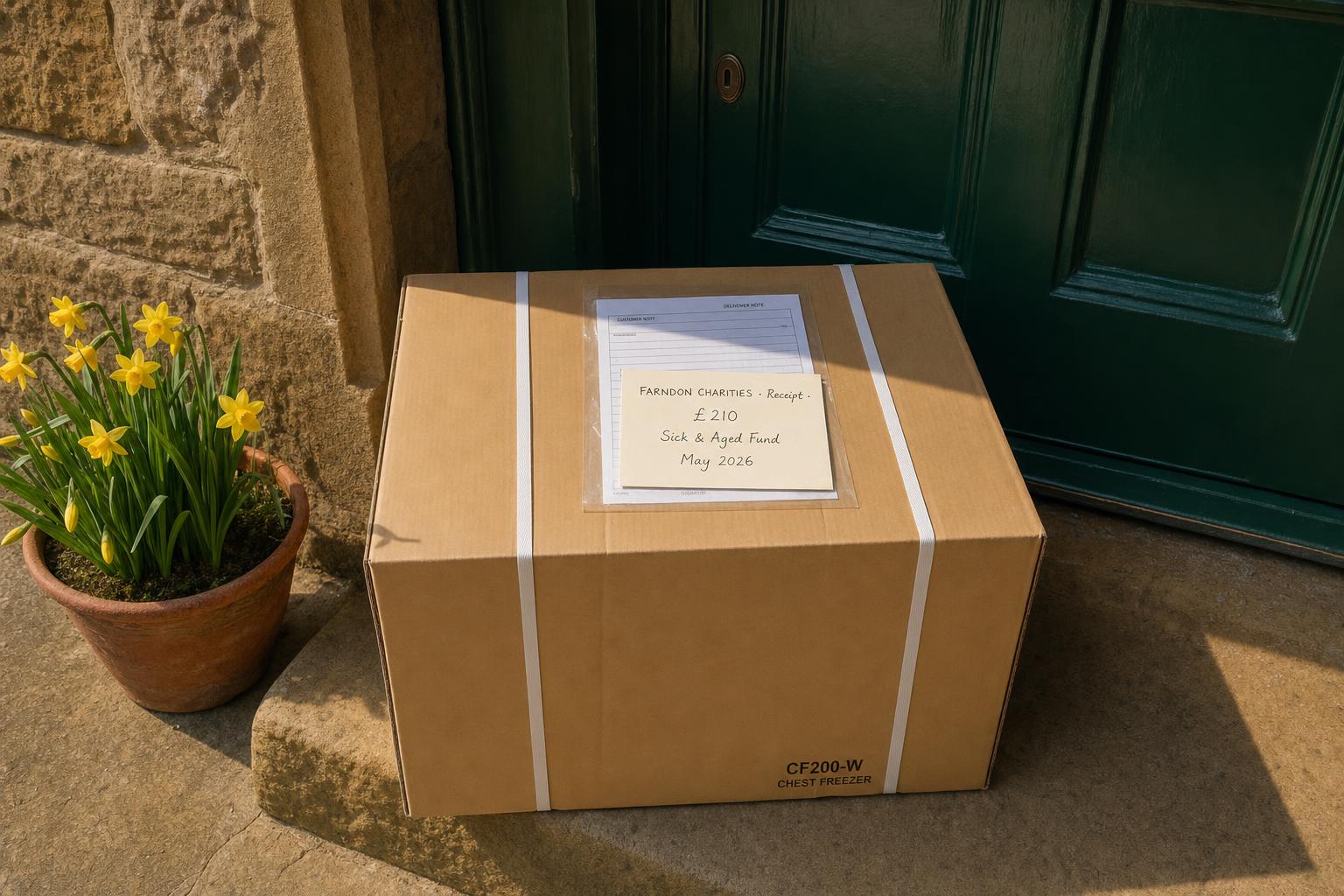
The first telephone call came in at half past nine on a Tuesday morning in May. The Rector, the Reverend David Scurr, was on the line. A neighbour in the back lane behind St Chad's, an older lady I shall call Margaret in this dispatch, had woken to find that her chest freezer — second-hand, ten years old, long since past warranty — had failed in the night. Everything in it was, of course, lost. More importantly, Margaret cooks in bulk on the first of the month and freezes the meals out across the four weeks; she lives alone, and the freezer is, in a quiet way, her larder. Without it, the month falls apart.
I have written before about the Sick & Aged Fund and its purpose. The Scheme of 1962 instructs us to relieve hardship arising from sickness, disability, or old age within the parish — the kind of small, urgent, real-world cost the welfare state does not cover. A failed freezer is, on the face of it, an unromantic case. It is also exactly the kind of thing the Fund exists for. It is a single piece of household equipment, the loss of which destabilises a household's budget for a fortnight; and the cost of replacing it (a basic chest freezer, from one of the high-street kitchen retailers in Chester) is a sum we can meet without difficulty: about £210 for the appliance, with delivery and disposal of the old one bundled.
The trustees were not due to meet for another six weeks. Under our Scheme, the chair may approve grants of up to £150 by chair's action between meetings, in consultation with the Clerk. £210 was a little over the threshold, but our long-standing convention is that the chair and Clerk may stretch to £250 where a single item of essential equipment is needed and the next meeting is more than four weeks away.
I telephoned David back at half past ten with my reading of the Scheme; we agreed the grant. Margaret's preference, asked of her by the Rector at her door, was for a like-for-like replacement — the smallest chest freezer in the range, not the upright her grandchildren had once suggested. I sent the order to the Chester showroom from my kitchen at quarter past eleven. The retailer has the village mapped; delivery was offered for Friday, then improved to Thursday lunchtime on the strength of a quick phone call from David.
It is not the freezer. It is the steadiness. The freezer is just the visible, lockable, audible proof that the steadiness has returned.
The freezer arrived on Thursday at 13.10. By Thursday evening, the kindly young man from the showroom had taken the old appliance away, swept the corner of the kitchen where it sits, and refused the cup of tea Margaret had pressed on him. Margaret herself spent Friday cooking. By Saturday lunch a small bag of meals was already in the new freezer; by Saturday evening it was, in her phrase to David, ‘up and running again.’
I went round on Sunday afternoon to write up the case in the ledger and to deliver the small Farndon Charities receipt slip that we ask every recipient to keep. (It is a slip of paper roughly the size of a postcard, printed on a pad we have had since 1997. It records the date, the fund, and the sum.) Margaret made us tea. We sat at the kitchen table and looked at the new appliance and she told me, in the manner of someone reading a recipe aloud, what she had cooked in it that week.
What I learned about turnaround time
The Scheme of 1962 imagined the trustees acting at the speed of the parish meeting — that is, quarterly. The 1987 revision permitted chair's action for ‘urgent need’. The 2004 revision permitted electronic payment. None of these reforms imagined a freezer arriving on a Thursday, paid for by debit card on a Tuesday, in response to a phone call that began at half past nine. And yet we did it, well within the spirit of the Scheme.
I am not entirely comfortable with the speed. Speed, for a small charity, is a risk. It is also a moral cost: each fast decision raises a quiet, unfair question for every slow one. Why did Margaret get a freezer in three days when another applicant might wait four weeks for an answer? My honest reply is that Margaret's case was both unambiguous and bounded in scale. The need was a single piece of equipment, replaceable for a known sum, and the alternative — an older neighbour eating out of cans for a month — was, to the chair and to me, plainly contrary to the purpose of the Fund.
There were a few moments in the week where I caught myself acting at the pace of an Amazon order rather than the pace of a trustee. I will, at the September meeting, ask my colleagues to set down in writing what the chair's-action upper limit is, and what the proper threshold of urgency looks like. We have always treated this as a matter of judgement, and I think we are right to; but it does no harm to write the judgement down.
What it is, and what it is not
It is tempting, in stories of this kind, to overstate the importance of the grant. The reality is more modest. A £210 freezer did not change Margaret's life. It did not solve the larger questions about how a parish like ours cares for older neighbours who live alone, or the still-larger questions about a state that, in 2026, is not as present at this scale of need as it once was. It cleared a single specific obstacle from one week of one householder's year. That is what the Sick & Aged Fund is for. It is not transformation. It is the small, real, useful thing.
And it was, in Margaret's phrase to me as I left on Sunday, ‘a lovely bit of help’. I asked her if I might quote that anonymously in this dispatch. She thought a moment, and said yes — and asked, very politely, if I might also note that the new freezer hums a little less than the old one, which is ‘a kindness to those of us who live alone with the radio on.’
So, for the record: the new freezer hums a little less than the old one.
Application by · the Rector of St Chad's · Date approved · Tuesday 5 May 2026 · Grant · £210 · Fund · the Sick & Aged Fund · Ledger ref · SA-2026-04-019
Help us reach the next Margaret in time
A small gift to the Sick & Aged Fund.
£60 is one small grant to a Farndon kitchen this winter. Three trustees, one ledger, no overhead — every pound stays in the parish.