Story · 21 April 2026 · The Apprentice Bequest
The first apprentice grants of 2026 — three trades, three young Farndonians.
The Apprentice Bequest is the youngest of our income-producing funds and, this spring, the busiest. A note from the trustee who carries the Apprentice portfolio on the three young people the Fund has just helped, and on the small but persistent gap that the fund exists to bridge.
By Margaret Clarke, Trustee (Apprentice portfolio)
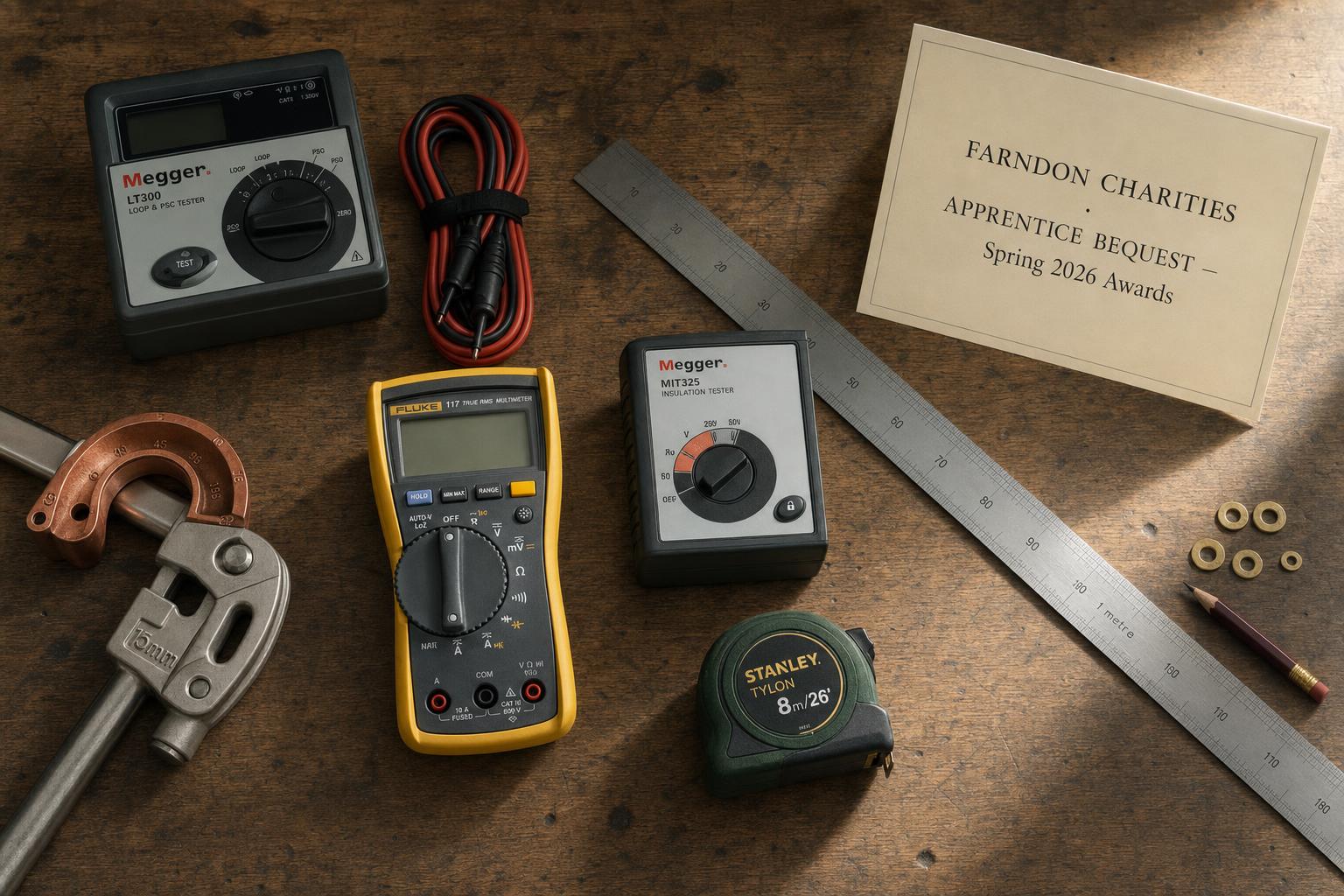
The Apprentice Bequest was founded in 1891 by the Reverend Thomas Allbright, then rector of Farndon, in memory of his daughter Caroline. Its founding deed asks us to use its income ‘to help young Farndonians enter the trades and the working life’. A century and a half later that wording still does most of the work for us; what has changed is what the trades and the working life actually cost a young person on their first day.
This spring the trustees considered nine applications under the Bequest. We were able to support three; we declined one on grounds of geography (the applicant was at Birkenhead with no Farndon connection); we deferred two pending more information; we suggested that two others might be better served by our own Poor's Allotment, where the need was more general than apprenticeship-specific; and we directed one to the Cheshire Community Foundation, which can fund at a scale we cannot. I shall write here about the three we supported, with their consent and with first names only.
Tom · electrician's apprentice
Tom is 19. He grew up off the High Street in Farndon, attended the village primary and then Christleton High in Chester, and started his electrician's apprenticeship at a Chester firm last September. The first year of the apprenticeship requires an unusually heavy kit list — not just hand tools, but a calibrated multimeter, a Loop & PSC tester, a Class II insulation tester, a conduit bender, a steel rule, and a pair of properly rated test leads. The firm contributes a portion of these via a kit-loan scheme; the apprentice is expected to own the rest by the end of the first year.
Tom's mother wrote to the trustees in February. The total balance to find — once the firm's loan and a small interest-free Cheshire West & Chester Council apprentice grant had been counted — came to £312. It was not, candidly, an unmanageable sum for a household with two incomes, but Tom's mother is widowed and the family had taken a heavy hit on his late father's pension in 2024. £312 was the difference between continuing the apprenticeship and dropping it for an immediate-pay job at a Chester warehouse.
The trustees met on 11 March and approved a grant of £250 from the Apprentice Bequest, with the family making up the remainder. The kit was complete by the end of March. Tom came round to my house on a Saturday afternoon to thank me and to show me, with shy pride, the new multimeter in its case. I asked him, as I ask all our Apprentice recipients, if he might write a line for the dispatch. His line was: ‘Tell people the small things really do help.’
Tools, work boots, the cost of getting to Chester for college. I didn't want to ask. The Apprentice Bequest made it possible to ask without it being a big thing.
Aisha · veterinary nursing
Aisha is 17 and is the first in her family to enter a regulated profession. She is on a Level 3 apprenticeship in veterinary nursing at a small mixed practice on the Wrexham Road, near Crewe-by-Farndon. The cost we helped with was unusual: not a kit list, but the deposit on a small one-bed flat in Chester, taken up so that Aisha could be within bus distance of her placement during her practice's on-call rota.
The deposit was £400, plus a first month's rent of £575. Cheshire West and Chester Council had a small grant available for the rent itself; the deposit was the gap. The trustees met on 11 March, after a careful conversation about whether a deposit (which, in principle, returns to the tenant at the end of the tenancy) fell within the Scheme's definition of ‘relief of hardship’. We concluded that it did, on the reasoning that without the deposit there was no flat, and without the flat there was no apprenticeship. We approved £300, with the family contributing the remainder.
Aisha's tenancy began on 25 March. We have agreed with her, in writing and on a single side of paper, that should the deposit be returned to her at the end of the tenancy unbroken, she will pass £300 of it back to the Apprentice Bequest. We do not normally make this kind of conditional arrangement, but where the underlying cost is genuinely refundable rather than spent, we think it appropriate. Aisha was, in her own phrase, ‘completely fine with that’.
Daniel · plumbing
Daniel is 21 and is, in the technical phrase, a ‘late starter’: he had a job in retail for three years after leaving school and is now turning to plumbing. His application came to us via the duty officer at Citizens Advice Cheshire West, with whom he had been discussing his options. The trustees liked the application immediately. It was thoughtful, specific, and honest about what it was for: workwear, a set of basic hand tools, and the bus fare for three months while he waited to qualify for the apprentice pay step that would make the journey from Farndon to Chester self-funding.
Daniel asked for £180. We approved £200 (the small over-grant on the recommendation of Clive, our Honorary Clerk, who pointed out that the cost of decent steel-toecap boots had risen recently). Daniel started his apprenticeship on 3 April. He has, since then, sent us a postcard of the river at Holt with a single sentence on the back: ‘Off we go. Thank you both.’
What the three cases have in common
Each of the three applications turned, in the end, on a relatively small sum: £250, £300, £200. Together that is £750, or about 1.7 per cent of an average year's grant-making at a typical Cheshire community-foundation scale. To us, it is most of a quarter's distribution under the Apprentice Bequest. Each grant solved a specific, identifiable obstacle to a specific, identifiable young person starting a trade. Each applicant had already taken every other reasonable step (council grants, kit-loan schemes, family contributions). In each case, we were not the first port of call; we were, very precisely, the small piece of the puzzle that no other funder was set up to provide.
The Apprentice Bequest is a small fund. It will not, in any year, transform the prospects of young people in this parish. But it is, in 2026, doing the thing the Reverend Allbright asked it to do in 1891 — helping young Farndonians enter the trades and the working life. We are quietly proud of that.
If you are a young person from the parish
The Apprentice Bequest considers applications four times a year, with our quarterly meetings in March, June, September, and December. There is no application form. A short letter or email — telling us your name, your apprenticeship, your training provider, and what specific thing you need help with — is more than enough. Please write to me, care of the trustees, at 6 Plover Close, Farndon, Chester, CH3 6RG; or, more easily, to [email protected].
Ledger refs · AB-2026-03-014 · AB-2026-03-015 · AB-2026-03-016 · Total awarded · £750
Support the next set of apprentice grants
£60 helps a Farndon apprentice meet a kit-list shortfall.
The Apprentice Bequest is funded by historic endowment and parish gifts. A single donation can be the deciding £60 in the next round.